
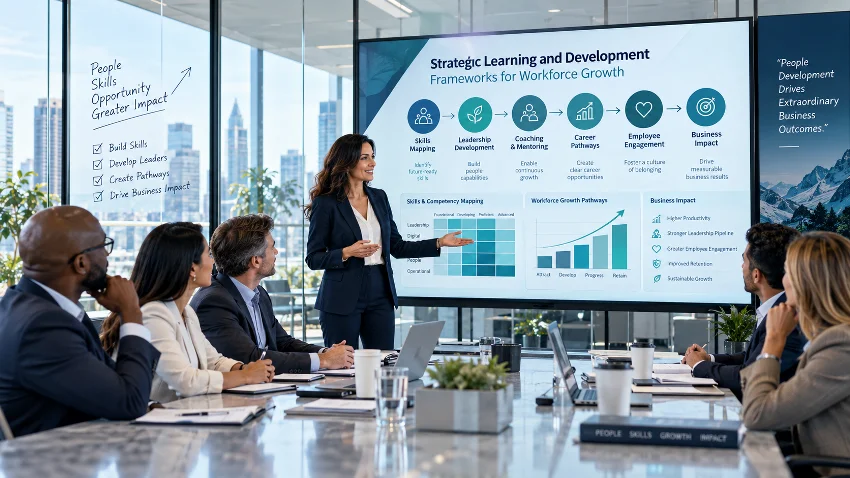
A company’s biggest competitive advantage isn’t always its technology, products, or financial resources. More often, it’s the people who know how to adapt, solve problems, and keep improving when business conditions change.
That’s where strategic Learning and Development becomes essential.
Instead of treating employee training as an occasional HR activity, successful organizations connect professional growth with business priorities, workforce capabilities, and long-term performance. The challenge is creating programs that employees actually benefit from while delivering measurable organizational value. With the right frameworks, technology, and leadership support, corporate learning can become a powerful driver of sustainable growth.
1. Understanding Strategic Learning and Development in Modern Enterprises
Strategic workforce development focuses on building the knowledge, abilities, and professional capabilities employees need to support organizational objectives.
Unlike traditional training programs, a strategic approach considers current performance requirements alongside future business challenges.
It combines formal education, workplace experience, coaching, leadership development, and career progression into a coordinated talent strategy.
Moving Beyond Traditional Employee Training
Traditional corporate training often revolves around scheduled workshops, mandatory courses, and annual training budgets.
These activities can provide value, but they don’t automatically translate into better workplace performance.
An employee might complete a leadership course without receiving opportunities to practise decision-making or manage actual projects.
Strategic development addresses this disconnect by linking educational activities with practical application.
For example, a company preparing to expand internationally may develop cross-cultural communication, international project management, and regional leadership capabilities.
The objective is not simply increasing training participation. It’s preparing employees to handle responsibilities that directly support business expansion.
Why Workforce Capabilities Matter
Modern businesses face technological disruption, evolving customer expectations, and changing skill requirements.
The OECD Skills Outlook 2023 highlights the importance of continuous upskilling and reskilling as organizations navigate digital and environmental transformations.
When companies fail to update workforce capabilities, operational performance may decline even when their technology remains competitive.
Employees need opportunities to refresh existing skills and develop entirely new competencies.
A strong development strategy supports adaptability while helping organizations reduce dependence on external recruitment for every emerging capability.
Connecting Employee Growth With Business Performance
The most effective learning strategies start with business priorities.
A manufacturing organization may concentrate on operational safety and technical proficiency, while a financial institution emphasizes risk management and regulatory knowledge.
Technology companies might prioritize cloud engineering, cybersecurity, and artificial intelligence literacy.
Each organization should establish a clear connection between its development investments and the outcomes it expects.
This connection helps executives understand why employee growth deserves sustained attention rather than occasional funding.
2. Building an Enterprise Learning and Development Framework
An enterprise development framework creates a structured approach to identifying learning requirements, delivering suitable programs, and evaluating outcomes.
Without a consistent framework, individual departments may introduce overlapping courses, conflicting competency standards, and disconnected development initiatives.
Aligning Learning Strategy With Organizational Objectives
The Chartered Institute of Personnel and Development emphasizes that an effective development strategy should form part of an organization’s wider business strategy.
This means understanding operational priorities before deciding which training programs to purchase or create.
Consider a company planning to introduce automated production systems across multiple facilities.
Its workforce strategy may need to address equipment maintenance, data interpretation, process supervision, and change management.
Rather than offering generic digital training, the organization can build role-specific development pathways.
These pathways should reflect both immediate operational needs and capabilities required during later implementation stages.
Applying the ADDIE Instructional Design Model
ADDIE is a widely used framework for designing structured learning experiences.
Its five stages are Analysis, Design, Development, Implementation, and Evaluation.
During analysis, learning teams identify the performance problem and determine whether training is an appropriate solution.
The design stage defines objectives, assessment methods, and instructional approaches.
Development involves creating materials and practical exercises, while implementation introduces the program to learners.
Evaluation examines whether the intervention meets its objectives and where improvements are required.
Although ADDIE is often presented sequentially, practical implementations can revisit earlier stages as new information becomes available.
Using the Talent Development Capability Model
The Association for Talent Development provides a capability framework covering essential skills for talent development professionals.
Its model identifies 23 capabilities across three areas: personal capability, professional capability, and organizational impact.
These areas include instructional design, coaching, career development, performance improvement, business insight, and data analytics.
Organizations can use this framework to examine the effectiveness of their internal development teams.
For example, a learning department with strong course production capabilities may still need to improve strategic consulting or performance measurement.
Developing the capabilities of learning professionals helps improve the quality of programs delivered throughout the organization.
Establishing Learning Governance
Governance defines how learning initiatives are approved, managed, evaluated, and updated.
A centralized learning team can establish common competency definitions and quality standards.
Department managers can then adapt training to local operational requirements.
This balance reduces duplication without forcing every employee into identical learning experiences.
Clear governance also identifies who owns content accuracy, assessment requirements, training records, and ongoing improvements.
3. Workforce Skills Mapping and Strategic Capability Planning
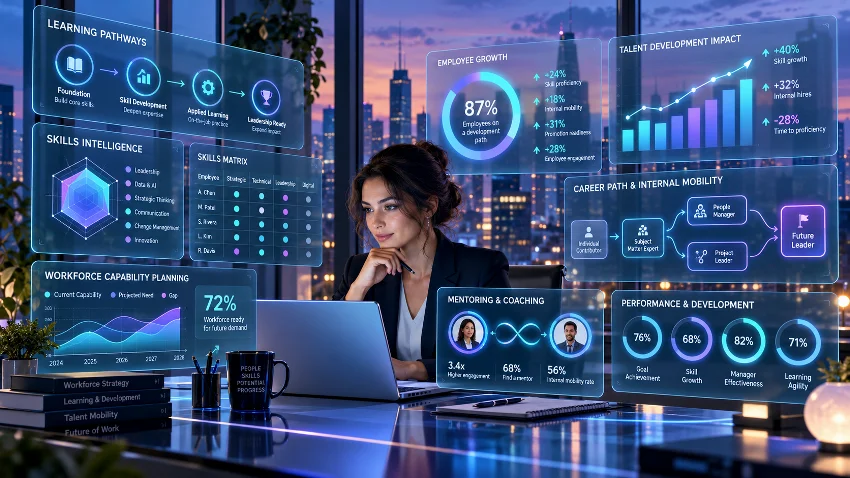
Organizations cannot develop the right capabilities without understanding what employees already know.
Skills mapping provides a structured way to compare existing workforce strengths with current and future organizational requirements.
Conducting a Skills Gap Analysis
A skills gap analysis begins by defining the capabilities required for specific roles.
These requirements may include technical knowledge, problem-solving ability, communication skills, regulatory understanding, and leadership competencies.
Organizations can gather evidence through practical assessments, work samples, performance observations, and validated competency evaluations.
Suppose a company needs 120 employees proficient in advanced data analysis but currently has only 75.
The immediate capability gap involves 45 positions, assuming each employee represents one required position and skill proficiency has been assessed consistently.
However, the organization should also examine proficiency levels and future demand rather than relying exclusively on employee counts.
Creating a Competency Matrix
A competency matrix helps visualize workforce capabilities across teams.
For example, a simplified proficiency scale might range from Level 1, basic awareness, to Level 4, independent expertise.
Employees can be evaluated against role-specific requirements using consistent assessment criteria.
A project manager might need advanced stakeholder communication, intermediate financial analysis, and expert-level project planning.
The resulting matrix supports development priorities, workforce allocation, and succession planning.
However, ratings should be based on observable evidence rather than personal impressions alone.
Connecting Skills With Career Pathways
Employees become more motivated when they understand how acquiring new skills can support career progression.
LinkedIn’s 2025 Workplace Learning Report identifies career advancement as a major motivation for workplace learning.
The report also found that 49% of surveyed learning and talent development professionals agreed their executives were concerned about employees lacking skills needed to execute business strategy.
These findings reinforce the importance of connecting development programs with practical career opportunities.
Organizations can establish transparent progression frameworks showing the capabilities needed for different roles.
An employee interested in moving from customer support into operations management could follow a development pathway covering process improvement, reporting, team coordination, and leadership.
Clear career pathways make educational investments more personally meaningful.
Planning for Future Workforce Requirements
Strategic capability planning should account for anticipated changes in technology, industry conditions, and organizational structure.
Scenario planning allows companies to consider several possible futures.
For example, a logistics company may evaluate how increasing warehouse automation could change demand for maintenance technicians, data analysts, and operations supervisors.
The company can then begin developing relevant capabilities before implementation is complete.
This forward-looking approach reduces the pressure to respond to every skills shortage through urgent recruitment.
4. Designing Effective Corporate Learning Experiences
Employees learn in different ways, depending on their responsibilities, experience, motivation, and working environment.
An effective enterprise learning ecosystem combines suitable delivery methods rather than relying on one training format.
Blended Learning and Experiential Development
Blended learning combines digital instruction with face-to-face interaction, coaching, or practical assignments.
For instance, new managers might complete short online modules before participating in facilitated leadership workshops.
They could then apply the material through supervised workplace projects.
This approach helps connect conceptual understanding with real organizational situations.
Experiential learning is particularly valuable when employees need to develop judgment, communication, or complex problem-solving abilities.
However, practical activities should have clear objectives and opportunities for feedback.
Applying the 70-20-10 Learning Concept
The 70-20-10 model is often used as a planning heuristic for workplace development.
It suggests considering learning through experience, social interaction, and formal instruction.
The commonly cited proportions are 70% experiential, 20% social, and 10% formal learning.
However, these figures should not be treated as scientifically established percentages that every organization must follow.
Their practical value lies in encouraging development teams to look beyond classroom-based education.
An aspiring team leader might gain experience by managing a small project, receive mentoring from a senior manager, and attend formal leadership workshops.
Each activity supports a different aspect of professional development.
Microlearning and Learning Reinforcement
Microlearning delivers focused educational content through relatively short learning activities.
This approach can be useful for software updates, product knowledge, operational procedures, and quick knowledge refreshers.
For example, retail employees may benefit from short modules explaining changes in payment systems.
However, complicated capabilities require more comprehensive instruction.
Advanced negotiation, engineering design, and strategic leadership cannot usually be mastered through brief videos alone.
Learning reinforcement through practice, feedback, and spaced review helps employees retain important information.
Encouraging Psychological Safety and Learning Culture
Employees are more likely to explore unfamiliar ideas when they can ask questions without unnecessary embarrassment.
Managers play an important role in creating this environment.
They can encourage constructive feedback, discuss lessons from mistakes, and recognize employees who share useful knowledge.
A healthy learning culture doesn’t mean ignoring performance standards.
It means treating development as an ongoing responsibility rather than a response to individual failure.
Organizations that support experimentation alongside accountability can create more meaningful opportunities for professional growth.
5. Leveraging Technology and AI for Workforce Development
Digital learning technology allows organizations to coordinate development programs across departments, locations, and job roles.
However, technology should support educational objectives rather than determine them.
Learning Management Systems and Learning Platforms
A learning management system provides centralized tools for course delivery, enrollment, assessment, and progress tracking.
Enterprise platforms may integrate with human resources systems, identity management services, and business intelligence applications.
These connections help administrators assign relevant training based on job responsibilities.
For example, an employee promoted into a supervisory role might automatically receive management training requirements.
Learning experience platforms can complement these systems by supporting content discovery and personalized recommendations.
Organizations should evaluate accessibility, data protection, integration flexibility, and reporting capabilities before selecting technology.
AI-Powered Personalized Learning
Artificial intelligence can assist with recommending educational resources based on skills, roles, and development objectives.
An employee preparing for a cybersecurity position might receive suggestions covering networking fundamentals, threat analysis, and security operations.
AI tools can also help summarize learning materials, generate practice questions, and support conversational tutoring.
However, AI-generated information requires appropriate verification.
Organizations should examine recommendation accuracy, potential bias, employee privacy, and the quality of underlying content.
Human oversight remains particularly important when systems influence certification decisions or professional advancement.
Skills Intelligence and Learning Analytics
Skills intelligence platforms combine information about workforce capabilities, job requirements, and development opportunities.
These systems may help organizations identify emerging capability gaps.
For example, analytics could reveal increasing demand for cloud security expertise across several departments.
Learning teams can then prioritize relevant programs and coordinate internal development opportunities.
Nevertheless, skills data is rarely perfect.
Self-reported abilities, course completions, and job titles should not automatically be treated as proof of professional competence.
Supporting Digital Accessibility
Effective digital development programs should remain accessible to employees with different abilities, devices, and working conditions.
Features such as video captions, keyboard navigation, readable content, and mobile-friendly interfaces improve usability.
Frontline employees may require flexible access because their schedules differ from those of office-based teams.
Organizations should also consider language requirements and connectivity limitations.
Accessible design supports more equitable participation and reduces unnecessary barriers to workforce growth.
6. Leadership Development, Coaching, and Internal Mobility
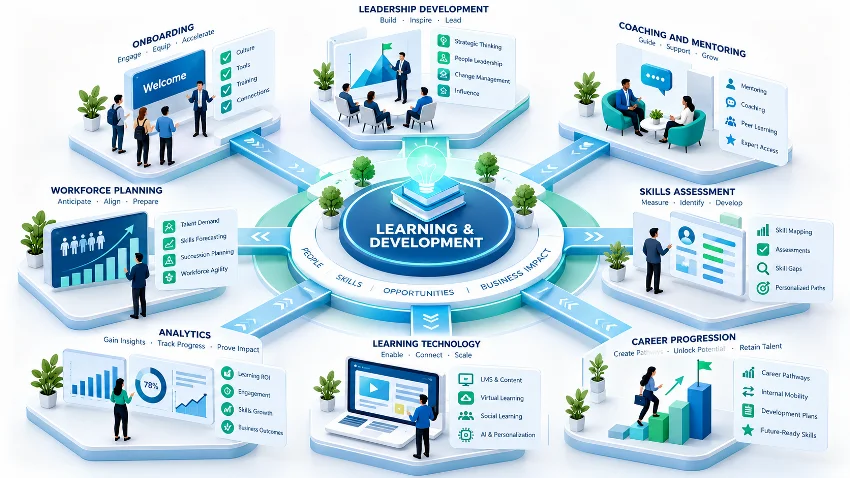
Technical training alone cannot create a high-performing workforce.
Organizations also need effective managers, clear career opportunities, and systems that encourage employees to apply their developing capabilities.
Building Leadership Development Pipelines
Leadership development should begin before employees receive formal management responsibilities.
Potential leaders can gain experience through project coordination, cross-functional assignments, mentoring, and decision-making exercises.
A structured leadership pathway may cover communication, conflict resolution, strategic planning, financial awareness, and team development.
However, leadership potential should not be judged only by technical performance.
An excellent engineer may need additional interpersonal development before managing an engineering team effectively.
Assessment methods should reflect the actual requirements of leadership positions.
Coaching and Mentoring Programs
Coaching focuses on helping individuals improve specific capabilities or performance outcomes.
Mentoring typically involves broader professional guidance based on experience.
Both approaches can complement structured education.
For example, a new department manager might work with a coach to improve difficult conversations while receiving career guidance from a senior executive.
Successful programs require clear expectations, confidentiality boundaries, and suitable matching processes.
Regular reviews help determine whether participants are making meaningful progress.
Encouraging Internal Talent Mobility
Internal mobility allows employees to move between roles, departments, or projects within an organization.
It can provide practical development opportunities while helping companies use existing capabilities more effectively.
A marketing analyst interested in product management might participate in cross-functional product initiatives.
Through these assignments, the employee gains experience without immediately leaving their current position.
LinkedIn’s 2025 research associates mature career development practices with stronger organizational confidence in talent attraction, retention, and business performance.
These relationships are useful strategic signals, although they should not automatically be interpreted as proof of causation.
Managers as Development Partners
Learning departments cannot manage every employee’s professional growth independently.
Direct managers influence whether employees receive development opportunities and apply new skills.
Managers can establish individual growth objectives, recommend stretch assignments, and provide regular feedback.
They should also create reasonable opportunities for employees to participate in development activities.
When managers view learning as a distraction from productivity, even well-designed programs may struggle to succeed.
7. Measuring Learning Impact and Optimizing Workforce Development
A successful development strategy needs credible evidence.
Course participation, assessment scores, and training hours offer useful information, but they don’t necessarily demonstrate improved business performance.
Organizations should combine educational measures with operational outcomes.
Applying the Kirkpatrick Evaluation Model
The Kirkpatrick Model provides a framework for examining training effectiveness through four evaluation levels.
The first level, Reaction, evaluates how participants respond to the learning experience.
The second, Learning, examines acquired knowledge, skills, and other intended learning outcomes.
The third, Behavior, considers whether participants apply what they learned at work.
The fourth, Results, evaluates progress toward the intended organizational outcomes.
For example, a customer service training program might receive positive feedback and produce higher assessment scores.
However, its broader value depends on whether employees improve their workplace interactions and contribute to relevant service outcomes.
This framework encourages organizations to connect training design with measurable performance expectations.
Defining Strategic Learning KPIs
Learning indicators should reflect organizational objectives.
For technical certification programs, practical proficiency and certification achievement may be important.
Leadership initiatives might examine behavioral changes, team effectiveness, and readiness for increased responsibility.
Other useful indicators include skill-gap closure, employee participation, time to proficiency, and internal career progression.
Metrics should be interpreted together rather than treated as independent measures of success.
High course completion rates, for instance, may coexist with limited practical skill development.
Evaluating Training Return on Investment
A simplified training ROI formula is:
Training ROI (%) = [(Financial Benefits − Training Costs) / Training Costs] × 100
Imagine a workforce development initiative costs $120,000 and produces $180,000 in validated financial benefits.
The estimated ROI would equal 50%.
These figures are illustrative rather than industry benchmarks.
Organizations need reasonable evidence that the benefits result from the development initiative.
Comparing performance before and after training can help, but changes in staffing, technology, workload, and management practices must also be considered.
When financial attribution is difficult, nonfinancial measures can provide useful evidence of progress.
Continuous Improvement and Learning Governance
Development programs should be reviewed regularly.
Organizations can examine employee feedback, assessment results, operational performance, and changing competency requirements.
If a program produces strong assessment scores but limited workplace application, managers may need to provide additional coaching or practise opportunities.
Content may also require revision when technologies, regulations, or business processes change.
A structured improvement cycle supports better program quality and more effective resource allocation.
8. Creating a Future-Ready Workforce Development Roadmap
Workforce development becomes more valuable when organizations treat it as a continuous strategic process.
Rather than launching isolated programs, enterprises should establish a coordinated roadmap connecting present requirements with future capabilities.
Establishing a Phased Development Strategy
An effective roadmap can begin with a workforce capability assessment.
The organization then identifies priority skill gaps and selects development methods aligned with business needs.
Pilot programs can test learning experiences before wider implementation.
For example, a business might initially introduce a digital leadership pathway to 100 managers.
Feedback, practical assessments, and performance observations can help determine which elements should be refined.
After demonstrating value, the initiative can expand to additional teams.
Preparing for Emerging Skill Requirements
Artificial intelligence, automation, environmental sustainability, and changing workforce expectations will continue influencing professional capabilities.
The OECD emphasizes the importance of lifelong learning and adaptable skills in responding to digital and green transitions.
Organizations should regularly examine how these developments affect different job families.
Some employees may need entirely new technical competencies, while others require stronger critical thinking, collaboration, or decision-making capabilities.
A future-ready strategy combines specialized expertise with adaptable professional skills.
Building a Sustainable Learning Ecosystem
Long-term workforce development requires cooperation among HR teams, business leaders, managers, and employees.
Clear competency standards, reliable learning technology, appropriate budgets, and meaningful career pathways create the foundation.
However, the strongest programs also encourage employees to take an active role in their own growth.
Individual development plans should connect personal ambitions with organizational opportunities wherever practical.
Regular strategy reviews allow enterprises to adjust investment priorities as conditions change.
The ultimate objective is a workforce that can continously learn, adapt, and contribute to evolving business goals.
Strategic Learning and Development transforms employee training into a structured approach to workforce growth, leadership readiness, and organizational performance.
By connecting capability planning, practical learning experiences, technology, and measurable outcomes, companies can develop more adaptable teams. Sustainable success requires consistent leadership support and continous improvement.
Continue exploring the subject through a collection of supplementary insights and related information. Browse additional resources to uncover useful explanations, examine different viewpoints, and identify interesting connections. These references can help broaden your perspective while supporting further research beyond the original article.
GetMobilePrices.com ⭒ Routerlinksyssmartwifi.com ⭒ Fikretorman.online ⭒ TheNorthpoleBar.co.uk ⭒ SingleSmokers.co.uk ⭒ Stromectol1h.top ⭒ Eclector.co.uk ⭒ KetoPremiere.cc ⭒ Atozmp3.ws ⭒ Bside-rock.com ⭒ Ukinvestmentadvice.co.uk ⭒ Buzfeed.org ⭒ MakerFieldSpring.co.uk ⭒ WhiteSwillWinParty.org ⭒ VisitLizardCornwall.co.uk ⭒ Big-HeadBasketball.com ⭒ VideoReview.ws ⭒ Woodstock-Exhibition.com ⭒ Ispaziorepository.com ⭒ Accesschc.org ⭒ Hydrophil.biz ⭒ SilentKnightsSoaring.org ⭒ RestorerMinistries.org ⭒ Bodybuilding-Blog.org ⭒ Davidsavillphotography.co.uk ⭒ BetterSingingVoice.com ⭒ 1kdailyprofit-official.com ⭒ JainSonUmbrella.com ⭒ Vr7uallms.com ⭒ Dz-Recrute.com ⭒ CuisineMetisse.com ⭒ Alphabetnyc.com ⭒ ProjectThinIce.org ⭒ Lympleylodge.co.uk ⭒ AmbProductions.co.uk ⭒ Johnpowellavs.co.uk ⭒ DakarRally.co.uk ⭒ Dumbletoncc.co.uk ⭒ BaconFromAcorns.com ⭒ LogMe.cyou ⭒ Ffmovies.cyou ⭒ Daily-News.cyou ⭒ AirTechNow.cyou ⭒ Avideo.cyou ⭒ OpenLoad.cyou ⭒ OwnerFinancing.cyou ⭒ Variable-Annuity.cyou ⭒ GoodBrand.cyou ⭒ InvestFutureNow.cyou ⭒ OceanBreeze.cyou ⭒ JustSummer.cyou ⭒ OneTech.cyou ⭒ Naturelv.cyou ⭒ DepositRetiree.cyou ⭒ CuteEye.cyou ⭒ NextVision.cyou ⭒ LordMovies.cyou ⭒ Excited.cyou ⭒ Exporelab.cyou ⭒ Supav.cyou ⭒ Astro.edu.pl ⭒ BeSmart.edu.pl ⭒ Biology.edu.pl ⭒ Bmi.edu.pl ⭒ Cent.edu.pl ⭒ Chemistry.edu.pl ⭒ Cholesterol.edu.pl ⭒ Cooking.edu.pl ⭒ Daily.edu.pl ⭒ Dance.edu.pl ⭒ Dental.edu.pl ⭒ Diet.edu.pl ⭒ Doctor.edu.pl ⭒ Econom.edu.pl ⭒ Engine.edu.pl ⭒ Fashion.edu.pl ⭒ Films.edu.pl ⭒ ForexForum.edu.pl ⭒ Games.edu.pl ⭒ Halkali.edu.pl ⭒ Hazard.edu.pl ⭒ HealthCollege.edu.pl ⭒ Journal.edu.pl ⭒ Kidsfun.edu.pl ⭒ Kila.edu.pl ⭒ Laws.edu.pl ⭒ Lets-Talk.edu.pl ⭒ Life.edu.pl ⭒ lifestyle.edu.pl ⭒ MakeupArt.edu.pl ⭒ Mid.edu.pl ⭒ Mil.edu.pl ⭒ Natural.edu.pl ⭒ Neural.edu.pl ⭒ NeuroSoft.edu.pl ⭒ Oak.edu.pl ⭒ Olza.edu.pl ⭒ Partner.edu.pl ⭒ PatoLogia.edu.pl ⭒ Philosophy.edu.pl ⭒ Podcast.edu.pl ⭒ Poker.edu.pl ⭒ PolisHighschool.edu.pl ⭒ Preceptor.edu.pl ⭒ Promotor.edu.pl ⭒ Psico.edu.pl ⭒ Sena.edu.pl ⭒ Social.edu.pl ⭒ WebNet.edu.pl ⭒ Wf.edu.pl ⭒ Work.edu.pl ⭒ Nowa.edu.pl ⭒ Sylva.edu.pl ⭒ Study.edu.pl ⭒ Slub.edu.pl ⭒ Nus.edu.pl ⭒ Unr.edu.pl ⭒ Umd.edu.pl ⭒ Upm.edu.pl ⭒ Tell.edu.pl ⭒ Vibes.oo.gd ⭒ Meetup.cc.nf ⭒ Discover.es.ht ⭒ Daily.ar.nf ⭒ Creative.in.nf ⭒ Style.it.nf ⭒ Fairy.mx.nf ⭒ Likeable.ro.nf ⭒ Mindset.ru.nf ⭒ Future.uk.nf ⭒ Genz.webs.nf ⭒ Truly.oo.gd ⭒ Dreamy.cc.nf ⭒ Scope.es.ht ⭒ Journey.ar.nf ⭒ Inspire.in.nf ⭒ Growth.it.nf ⭒ Rogue.ru.nf ⭒ Mint.uk.nf ⭒ Looks.webs.nf ⭒ Hub.oo.gd ⭒ Sight.cc.nf ⭒ Focus.es.ht ⭒ Digest.ar.nf ⭒ Flow.in.nf ⭒ Explore.it.nf ⭒ Ideas.mx.nf ⭒ Stories.ro.nf ⭒ Wisdom.ru.nf ⭒ Vision.uk.nf ⭒ Ost.webs.nf ⭒ Mart.oo.gd ⭒ Pulse.cc.nf ⭒ Prime.es.ht ⭒ Trend.in.nf ⭒ Advice.it.nf ⭒ Learn.mx.nf ⭒ Right.ro.nf ⭒ Wave.uk.nf ⭒ Nova.webs.nf ⭒ LifeSpace.cc ⭒ Witrynki.com.pl ⭒ Rsn.org.pl ⭒ Igg.org.pl ⭒ GoodStory.org.uk ⭒ AdPoint.co.za ⭒ Lvs.co.in ⭒ Gorank.biz.in ⭒ Budget.com.de ⭒ Muse.com.de ⭒ Viva.com.de ⭒ Cove.com.in ⭒ Cozy.com.in ⭒ Digi.com.in ⭒ Se.net.pl ⭒ Caz.edu.pl ⭒ Erz.edu.pl ⭒ E-book.com.pl ⭒ Total.org.pl ⭒ War.net.pl ⭒ Deko.my.id ⭒ Urbans.my.id ⭒ Citi.my.id ⭒ Kicks.my.id ⭒ Rings.my.id ⭒ Edus.my.id ⭒ Seeks.my.id ⭒ More.my.id ⭒ Reads.my.id ⭒ Finds.my.id ⭒ Words.my.id ⭒ Style.my.id ⭒ Mivo.my.id ⭒ Jelio.my.id ⭒ Zavi.my.id ⭒ Inspiro.my.id ⭒ Stylio.my.id ⭒ Trips.my.id ⭒ Trave.my.id ⭒ Move.my.id ⭒ Lane.my.id ⭒ Theory.my.id ⭒ Mosaic.my.id ⭒ Locale.my.id ⭒ Essence.my.id ⭒ Virela.my.id ⭒ Laluna.my.id ⭒ Evina.my.id ⭒ Zevora.my.id ⭒ Kultur.my.id ⭒ Pins.web.id ⭒ Tick.web.id ⭒ Netter.web.id ⭒ Pops.web.id ⭒ Cosmo.web.id ⭒ Huge.web.id ⭒ Minds.web.id ⭒ Reds.web.id ⭒ Techs.web.id ⭒ Meds.web.id ⭒ Arts.web.id ⭒ Mobi.web.id ⭒ Zelo.web.id ⭒ Lifes.web.id ⭒ Piknik.web.id ⭒ Tripy.web.id ⭒ Fins.biz.id ⭒ Deeps.biz.id ⭒ Dots.biz.id ⭒ Teen.biz.id ⭒ Gens.biz.id ⭒ Revo.biz.id ⭒ Tekun.biz.id ⭒ Hubs.biz.id ⭒ Spotiva.biz.id ⭒ Startiva.biz.id ⭒ Inves.biz.id ⭒ Biznex.biz.id ⭒ Growin.biz.id ⭒ Mufa.biz.id